A translation of pages 29-36 from the book "Traditional Tools of Japan" by Ichihiro Tsuchida, the famous Tokyo tool dealer and historian
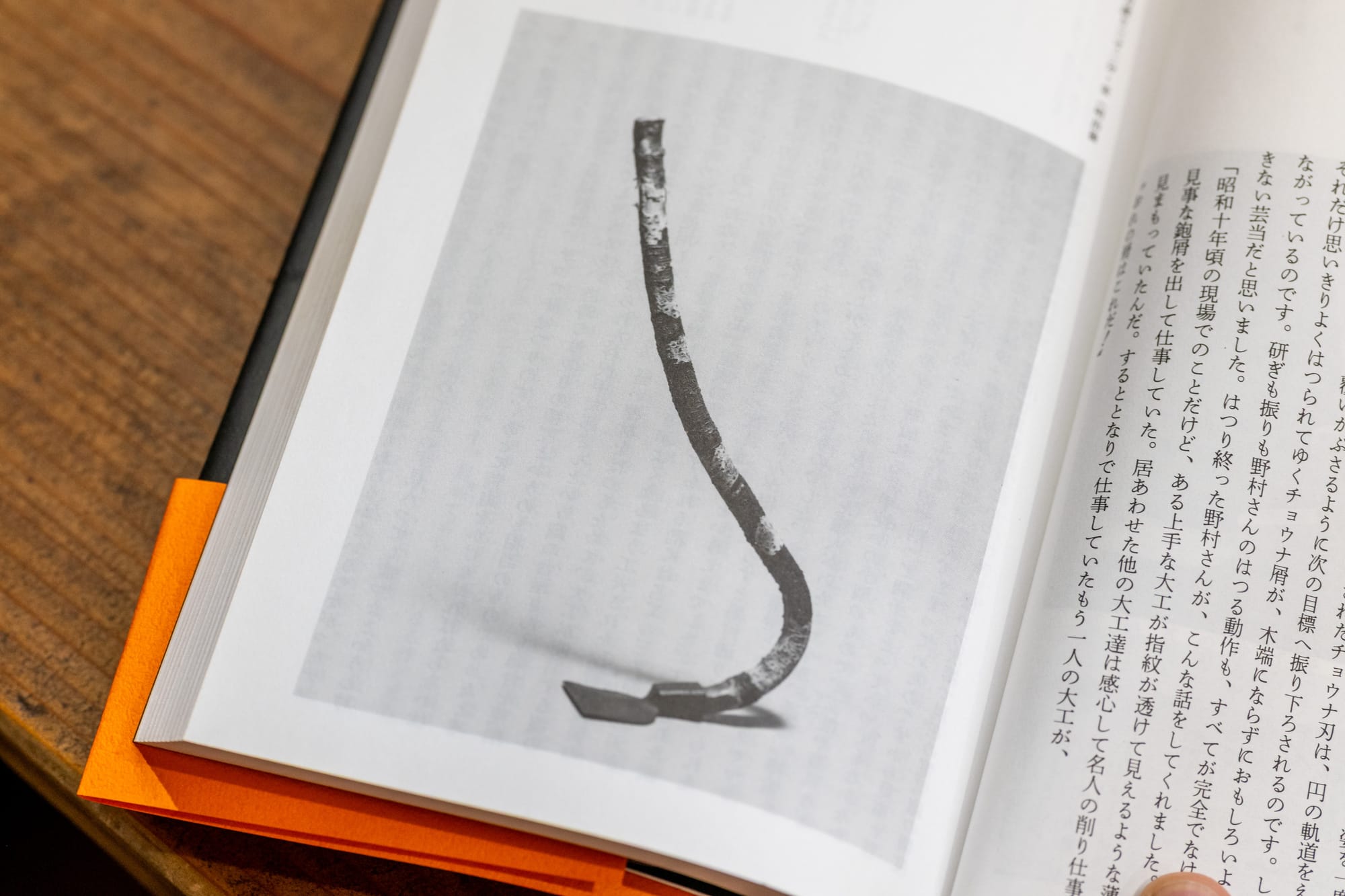
チョウナ (手斧)チョウナはじめという儀式があります。新年に大工が初めて仕事をする日に行なわれたり、あるいは新築の家の仕事にとりかかる日に行なわれるものです。地方によって、流派によって多少の違いはあるのでしょうが、その儀式には、チョウナと墨つぼと曲尺がまつられるのです。この三つの道具は、家を建てるためにはもちろん欠かせないものですが、何よりも大工が一番はじめに使用しなければならない道具でもあるのです。墨つぼと曲尺は墨つけ(かけ)という作業に使用され、チョウナは木材を加工するという意味においては、チョウナはつりと言って、一番はじめの荒加工に使用されるのです。日光の東照宮や奈良の東大寺などには特別に儀式用として作られた黒と曲尺とチョウナが大切に保存されています。墨などは全体に精密な彫金がほどこされ、まさにまつられるためにうまれて来た道具と言えましょう。日光東照宮におさめられているチョウナの柄(振り)には金の延板がまかれているのですから豪華なものです。しかし、そのチョウナの柄は全体の形がどうもよくないように思われます。チョウナのヒツにすげ込まれた部分から強い曲線で山をつくり、そこから手元に向かって今度は逆に反らされたゆるやかな曲線をえがくというのがチョウナ振りの理想です。重心をできる限りチョウナの刃先に近づけるように工夫されていてこそ、道具としての価値が示されます。たとえ儀式用といえども、そんな基本を無視してしまいますと、緊張感を欠いたものになってしまいます。
Chouna(adze)
There is a ritual called the Chouna-hajime. It is performed either on the day a carpenter first works in the new year, or on the day work begins on a new house project. While there may be slight variations by region and group, the ritual involves enshrining a chouna (adze), a sumitsubo (inkpot), and a sashigane (carpenter's square). These three tools are indispensable for building a house, but above all, they are the very first tools the carpenter must use. The sumitsubo and the square are used for marking out (sumi-tsuke/sumi-kake), while the chouna, in the sense of processing wood, is used for the very first rough carving/adzing(hatsuri). At places like the Toshogu Shrine in Nikko and Todai-ji Temple in Nara, a specially crafted sumitsubo, sashigane, and chouna made for ceremonial use are carefully preserved. The sumitsubo, for instance, is intricately engraved all over with gold decoration, is truly a tool born to be enshrined. The handle of the chouna enshrined at the Toshogu shrine is decorated with a sheet ofgold, making it quite luxurious. However, the overall shape of that chouna handle seems somewhat awkward. The ideal chouna handle design creates a strong curve forming a peak from the point where the it is fitted into the chouna's blade, then curves gently in the opposite direction toward the hand. Only when the center of gravity is carefully positioned as close as possible to the blade does the tool demonstrate its true value. Even for ceremonial use, ignoring such fundamentals results in a shape that is lackadaisical.