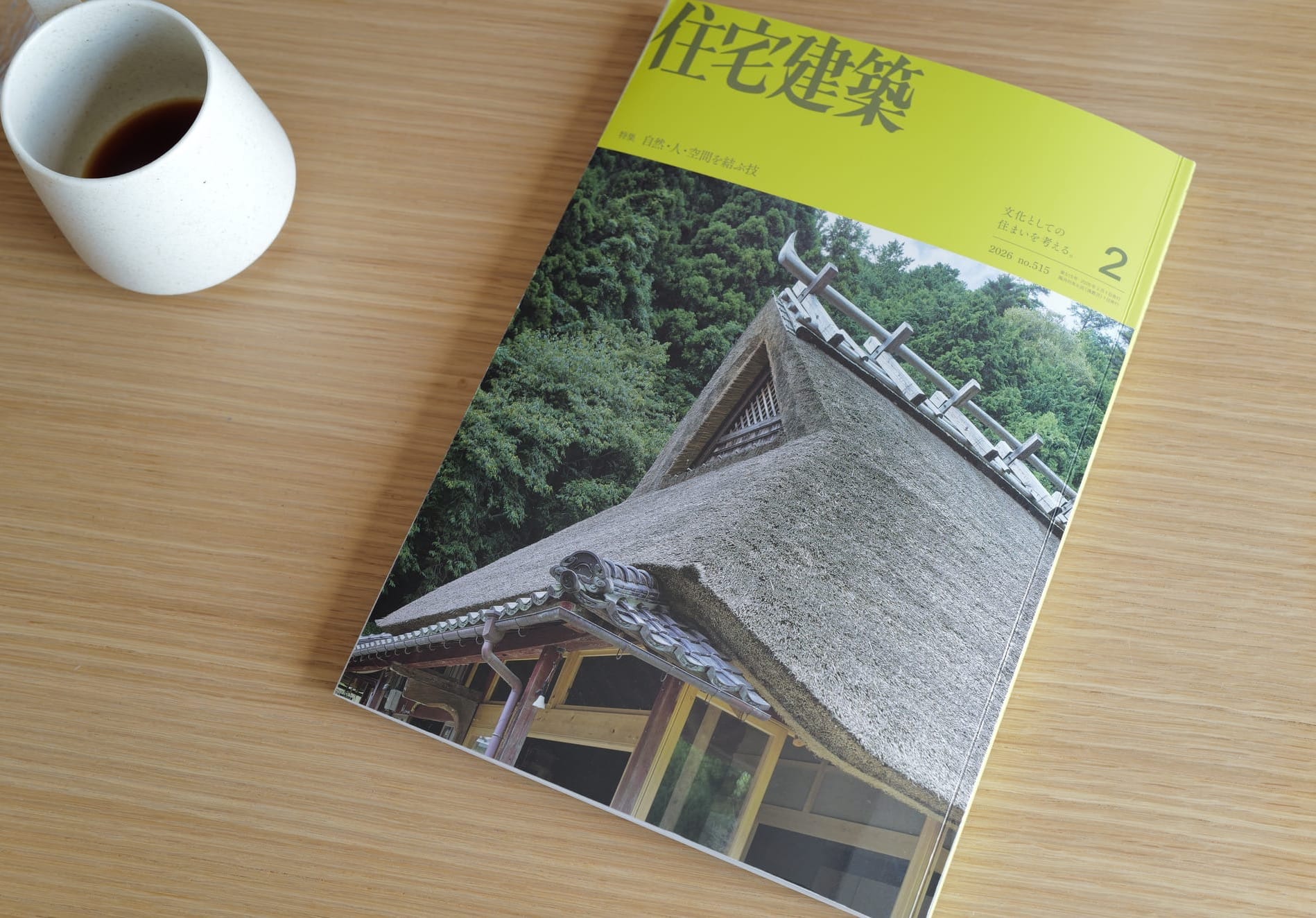
Somakosha was featured in 住宅建築 ("Residential Construction") magazine, a legendary glossy about fine buildings.
The first part of the article includes a piece by Kohei Yamamoto on the origins and philosophy of the company. Togo Miyashita, my friend and apprentice to Tak Yoshino, helped me translate the article into English. The magazine's self description is 文化としての住まいを考える建築専門誌— "An architecture journal for thinking about dwelling as culture." But this issue's special theme is "自然·人·空間を結ぶ技" or "The craft/skill that connects nature, people, and space."
You can get the magazine here, where there are more photos and diagrams. (The translations below include captions for images, and won't be fully useful without the publication in hand.)

住宅建築 自然·人·空間を結ぶ技
住宅建築The Art of Connecting Nature, People, and Space
p.5
1400年かけて培われた伝統構法でつくる
山本耕平/杣耕社代表、大工
Build with Traditional Construction Methods Cultivated Over 1400 Years
Kohei Yamamoto / Representative, Somakosha; Carpenter
戦後から日本の木造が変わった
独立以前は、岡山の新東住建工業というところで約8年間大工修業をさせてもらいました。主な仕事は文化財の修理や寺社仏閣の新築工事でした。修業時代に住宅の新築現場を通りかかった時に、私が今仕事で携わっている構法と全然違うことに驚きました。私がその時見たのは在来工法でした。
日本の木造建築の歴史を調べてみると、在来工法は明治時代に海外からの影響を少しずつ受けるようになったようです。日本の構法と交わり現在の在来工法の形へと定着していったようですが、まだ明治·大正の頃は過渡期だったと考えられます。戦後1950年に建築基準法が制定されると、一律の基準を満たした建物でないと建てられなくなりました。その際に木造建築は在来工法が主軸に置かれたため、急に増加していきました。一方で伝統構法は幸か不幸か、文化財修復の世界で生きながらえ、残存していくこととなります。
p.5
Japanese Wooden Construction Changed After the War
Before becoming self-employed, I trained as a carpenter for about eight years at Shinto-Jyuken Kogyo in Okayama. My main work involved repairing cultural properties and constructing new temples and shrines. During my apprenticeship, I passed by a new residential construction site and was shocked to see a construction method completely different from the one I now was engaging in. What I saw then was the conventional method.
Researching the history of Japanese timber construction reveals that the conventional method gradually began incorporating influences from overseas during the Meiji era. It seems to have blended with Japanese construction methods, eventually settling into the form of the current conventional method. However, the Meiji and Taisho periods were likely still a transitional phase. After the war, when the Building Standards Act was enacted in 1950, buildings could only be constructed if they met standardized criteria. At that time, traditional wood-frame construction became the primary method for wooden buildings, leading to a sudden increase in its use. On the other hand, traditional construction methods, for better or worse, survived and persisted within the field of cultural property restoration.
科学的な見地で伝統構法を再解釈
立命館大学の鈴木祥之先生は伝統構法の木造建築物の耐展化の権威と言われています。鈴木先生が阪神淡路大震災の折に被災地に足を運ぶと、伝統構法で建てられた古い民家で大きな被害なく残っていたものが数多くあったそうです。そこから伝統構法を研究しようという流れが起き、研究を重ねていくと伝統構法が地震に対しての「粘り強さ」があることが分かってきました。地震や日本の気候風土に対しての最適解である構法だということがようやく研究され始めたのです。
Reinterpreting Traditional Construction Methods from a Scientific Perspective
Professor Yoshiyuki Suzuki of Ritsumeikan University is considered an authority on the seismic resilience of traditional timber-frame buildings. When Professor Suzuki visited the disaster area after the Great Hanshin-Awaji Earthquake, he observed numerous older homes built using traditional methods that had survived with little damage. This prompted a movement to study traditional construction techniques. Through extensive research, it became clear that traditional methods possess a unique “resilience” against earthquakes. Research has finally begun to uncover these methods as the optimal solution for earthquakes and Japan's climate and natural environment.
伝統構法は先人たちの試行錯誤による賜物
私は、日本の伝統構法は1400年というとてつもなく長い実証実験、試行錯誤が繰り返されてきたことによる賜物だと思っています。例えば、中世の時代には斜材、つまり筋交いのようなものを入れた建築事例も残っていますが、その後、取り外している事案もあったようです。つまり建物を固くつくりすぎると倒壊しやすいということはすでに先人たちが理解していたのです。そうした細かな観察によって生み出された技術の一つが「貫」です。貫は柱に穴を開けてそこに横材として差してあるだけという単純な仕組みですが、柔軟性がありつつ架構の矩形を保ってくれる、非常によく考えられた組み方だと思います。鉄やコンクリートはとても固い素材ですが、強い力が架構にかかり変形すると元には戻りません。木は程よい弾力があるため、フレームが働いでも元に戻りやすい。貫に限らず、金物を使わない木組みは地震の衝撃に対して木の特性と架構に分散された継手、仕口が緩衝箇所となり、多少壊れる部分があっても建物は倒壊しにくくなっています。
他にも、石場建ては、縄文の頃の住居は掘立柱だったのが、地面に直接柱を埋めると腐が早いということが経験で分かってきた結果、石で柱と地面との縁を切り、柱を建てて足固めで繋ぎ、高床にして通風を確保する方法が確立されていったのではないかと推察します。
鈴木先生の実験で興味深かった実証結果があります。兵庫の振動大実験施設「Eディフェンス」で実際の建物を揺らしてみたところ、計算結果では「倒壊」と判定が出るのに対して、実結果では破損は見られても倒壊には至らなかったのです。現代では物事について実証する際に計算や数字に頼った過程を取る傾向にありますが、すべての事象に発生している物理法則を「計算」というかたちで網羅するには限界があります。AIや量子コンピューターの登場で、いずれ極めて精緻な物理現象を模擬実験できるようになるかもしれませんが、1400年という年月をかけた身体知を通じた思考錯誤の集大成に、まだまだ現代の科学が追いつけていないところがあるように感じます。
Traditional construction methods are the result of our ancestors' endless trial and error.
I believe Japan's traditional construction methods are the result of an incredibly long, 1400-year-long process of empirical testing and repeated trial and error. For example, while there are examples of medieval buildings incorporating diagonal bracing, similar to modern cross-bracing, there also seem to be cases where this bracing was later removed. This shows our ancestors already understood that making buildings too rigid made them prone to collapse. One technique born from such meticulous observation is the “Nuki” (penetrating tie beam). It's a simple mechanism: just making a hole in a pillar and inserting a horizontal beam through it. Yet, it's a remarkably well-thought-out assembly method that maintains the frame's rectangular shape while allowing flexibility. Materials like iron and concrete are very rigid; when strong forces deform the frame, it doesn't return to its original shape. Wood, however, has just the right amount of elasticity, allowing the frame to spring back more easily after being stressed. Not only in Nuki, but in any timber framing that avoids metal hardware, the inherent properties of wood and the distributed joints and connections within the framework act as shock absorbers against seismic impacts. This means that even if some parts break, the building is less likely to collapse.
Regarding stone-based construction, I speculate that the method evolved from Jomon-period dwellings using post-and-beam structures. Experience taught that embedding posts directly into the ground caused rapid decay. Consequently, stones were used to create a barrier between the posts and the ground. Posts were erected and connected with footings, creating elevated structures that ensured ventilation.
Professor Suzuki's experiments yielded fascinating empirical results. When an actual building was shaken at the Hyogo Prefecture seismic testing facility “E-Defense,” calculations predicted collapse, yet the actual results showed damage occurred without the structure collapsing. While modern verification often relies on calculations and data, there are limits to comprehensively capturing all physical laws governing phenomena through “calculation” alone. The advent of AI and quantum computers may eventually enable us to simulate extremely intricate physical phenomena through experiments. Yet, it feels as though modern science still hasn't caught up to the culmination of trial and error accumulated over 1,400 years through embodied knowledge.
ゴミを極力つくらない構法
私が修業をしていた頃はSDGsもサスティナビリティという言葉もあまり耳馴染みがありませんでしたが、大工になる以前に別の仕事をしていたときから「人間の営みってやたらゴミを出すなあ」と感じていました。一方で伝統構法の建物は、土はまた練り直せば土壁として使用でき、木は修繕や転用が容易で最終的に燃料になる。樹皮や紙、石といった生成過程の少ない素材はゴミとしての過大な処理を必要としないということを現場で実感していました。
2016年に熊本地震が発生した際、災害ボランティアに行きました。学校のグラウンドには倒壊した建物のゴミが大量に集められていて衝撃を受けました。それらのゴミは新建材が8割近く、リサイクルや焼却のできない埋め立てゴミとなったそうです。また2018年の西日本豪雨災害では、住宅の壁内や床下に汚水や汚泥が入ってしまい、在来工法で建てられた建物はその構造性質上、壊さないとそれらを除去し清掃復旧することができないという事案が数多く発生しました。それに対し、被災地で見た築120年の民家は、土が室内に流れ込んでしまっていたのにも関わらず、真壁造りだったため構造を清掃、乾燥後、新たに竹小舞を編み、左官仕事、畳を敷き直して比較的安易に復旧できたそうです。そういう経験もあり、自分がつくる建築の「手前側」や「向こう側」も考えなくてはならないと痛感させられました。
A Construction Method That Minimizes Waste
During my apprenticeship, terms like SDGs and sustainability weren't commonly heard. Yet even before becoming a carpenter, while working in another field, I felt that “human activities generate an absurd amount of waste.” In contrast, houses built with traditional methods use earth that can be reworked into walls, and wood that's easily repaired, repurposed, and ultimately becomes fuel. I witnessed firsthand how materials like bark, paper, and stone, which require minimal processing, don't necessitate excessive waste disposal.
When the 2016 Kumamoto Earthquake struck, I volunteered for disaster relief. I was shocked to see the school grounds piled high with debris from collapsed buildings. Nearly 80% of that debris was new construction materials, destined for landfill since they couldn't be recycled or incinerated. Similarly, during the 2018 Western Japan Heavy Rain Disaster, sewage and sludge flooded into the walls and under the floors of homes. Numerous cases occurred where buildings constructed using conventional methods couldn't be cleaned and restored without demolition, due to their structural nature. In contrast, a 120-year-old house I saw in the disaster area, despite having soil flow into the interior, was constructed with the Shinkabe-zukuri structure: the Japanese exposed-post-and-beam-style. This allowed for relatively straightforward restoration: after cleaning and drying the structure, new bamboo lath was woven, plastering work was done, and the tatami mats were replaced. Experiencing this made me keenly aware that I must also consider the “before” and “after” of the buildings I create.
最近、ある設計者から、石場建てで建てたいと相談を受けました。その方は石場建ての家を見る機会があったことで気持ちに変化が生まれたようです。やはり実際に見て触れることが鍵なんだなと感じました。その方が「石の上に木がドーンと立っているだけというのがいいですね」と言われたのが印象に残っています。
やまもと·こうへい談(文責=編集
Recently, a designer approached me with an interest in building an Ishiba-date: a stone foundation construction. It seems seeing such a house in person sparked a change in their perspective. It really drove home how crucial it is to see and touch things firsthand. What stuck with me was their comment: “I love how the wood just stands there, solid and grounded on the stone.”
Kohei Yamamoto
写真/Pictures
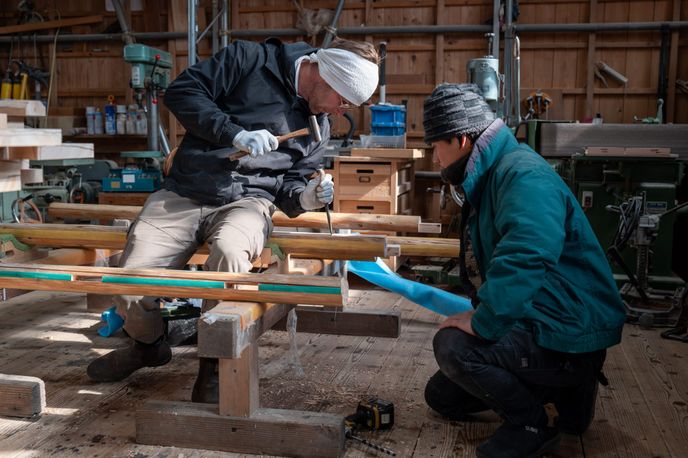
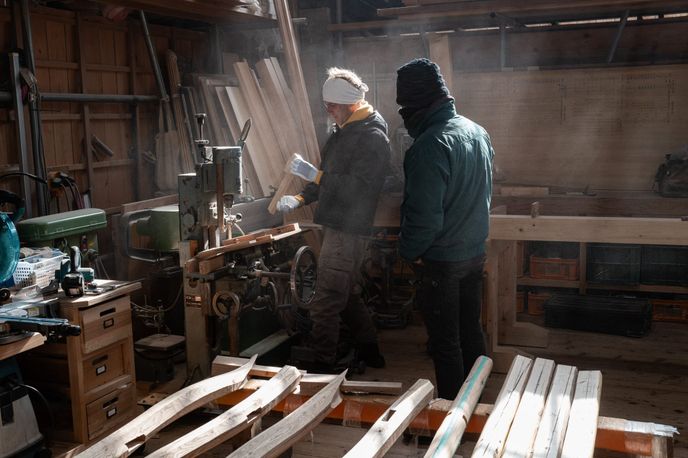
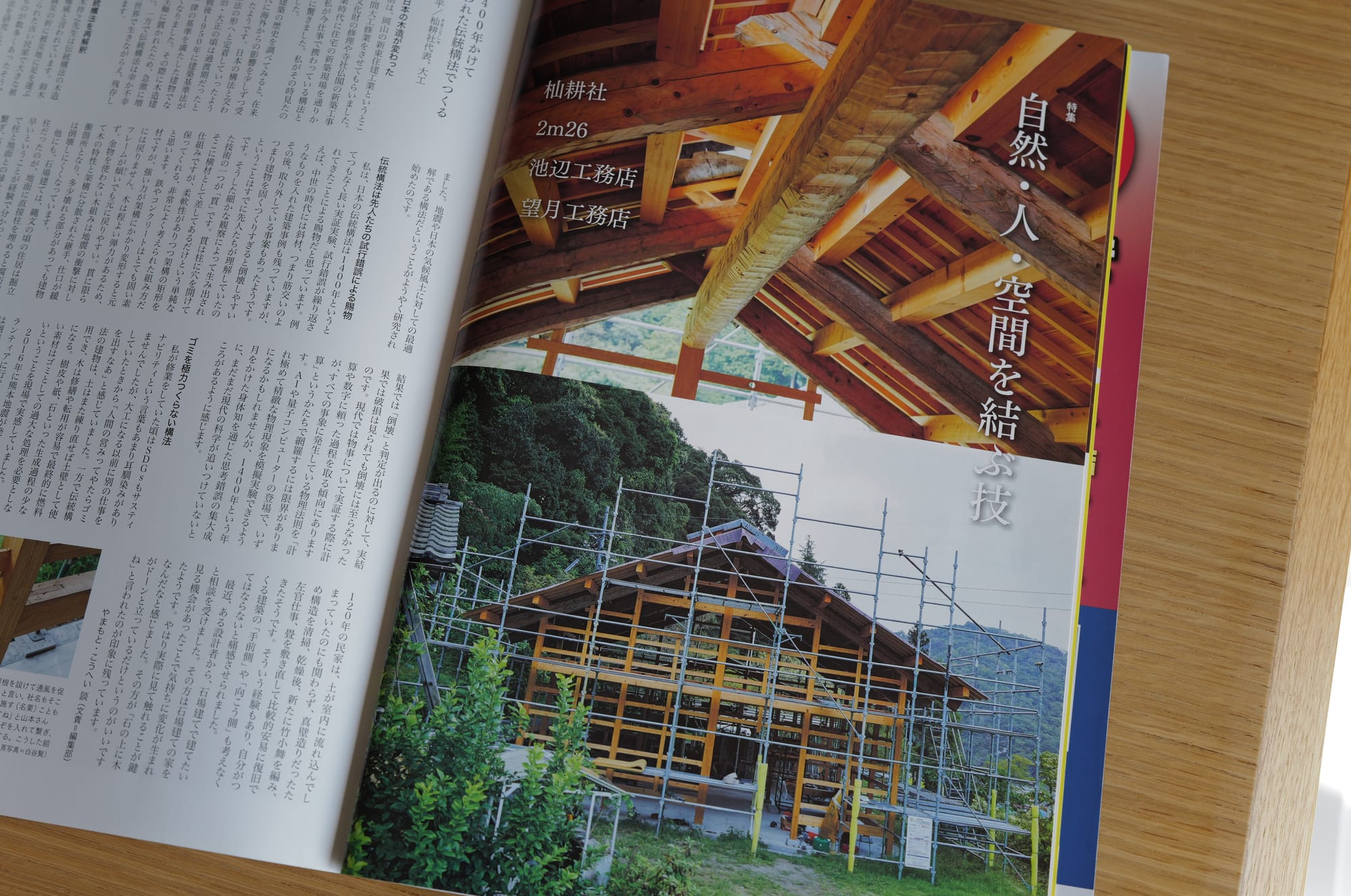
右写真2点/杣耕社が施工を進める岡山の現場。石場建て、貫を使い、越屋根を設けて通風を促す。手や大鋸などを使って手だけで加工することを「仕事(そましごと)」と言い、社名もそこから名付けた。先人たちの「杣」の技術を伝えたいと、梁や床材などにハツリを施す(名栗)ことも多い。「建主の好みにもよりますが、僕は人の手の気配が感じられるので好きですね」と山本さん
右写真/壁の形を保つ貫(上)と、柱同士を繋ぐ足固め(下)。足固めは、雇いほぞを入れて繋ぎ、込栓で締めている。部材を分けて繋ぐことで柔軟性が生まれ、地震の揺れに対応する。
こうした組み方も杣耕社の木組みの特徴
左写真/石を据えて、柱を置いた石場建て
Right photos (2): Somakosha's construction site in Okayama. Ishiba-date construction uses horizontal beams and features a cross-gabled roof to promote ventilation. The company name derives from “somashigoto”—the practice of handcrafting materials solely by hand using tools like chisels and large saws. Seeking to preserve the “somashigoto” techniques of our predecessors, they often apply naguri work(adzing) to beams and flooring. “It depends on the client's preference, but I personally like it because you can feel the human touch,” says Mr. Yamamoto.
Right photo: Horizontal Nuki beam (top) maintaining wall shape and footing braces (bottom) connecting columns. The foot brace is connected using mortise-and-tenon joints and secured with dowels. Connecting components separately creates flexibility, allowing the structure to respond to seismic shaking.
This assembly method is also characteristic of Somakosha's timber framing.
Left photo: Ishiba-date stone foundation construction, where stones are set and pillars placed upon them.
p.6
大工の技で蘇る築100年の民家
ストーレンマイヤー邸
岡山県岡山市
改修設計=杣耕社/ストーレンマイヤー·ジョナサン·アラン
施工=杣耕社
A Century-Old House Reborn Through Carpentry Craftsmanship
The Stollenmeyer Residence
Okayama City, Okayama Prefecture
Renovation Design = Somakosha / Jonathan Alan Stollenmeyer
Construction = Somakosha
p.9
計画は、築年数を重ねた古民家を再生し、現代のライフスタイルに寄り添った居心地の良さを加えるとともに、素材や工法を実験的に試し、五感で体験できる「建築の研究所」としての機能をもたせたプロジェクトである。
The project involves revitalizing an aged traditional house, enhancing its comfort to suit contemporary lifestyles while also serving as an “architectural laboratory” where materials and construction methods are experimentally tested, creating an experience engaging all five senses.
設計の大きな特徴は、異なる仕様を意図的に同居させ、それぞれの良さや経年変化を体感できるようにした点にある。たとえば屋根材は、主屋に本燻し瓦、小屋には釉薬瓦、下屋には一文字板金を採用。床板も、玄関と居間で加工方法を変え、素材の風合いの違いを来訪者が足裏で感じ取れるようにした。断熱材についても、壁には使用せず床下と天井裏のみに限定。日本家屋のもつ通風や日射遮蔽の工夫を活かしながら、夏冬ともに快適な室内環境が実現できることを示す実験的試みである。
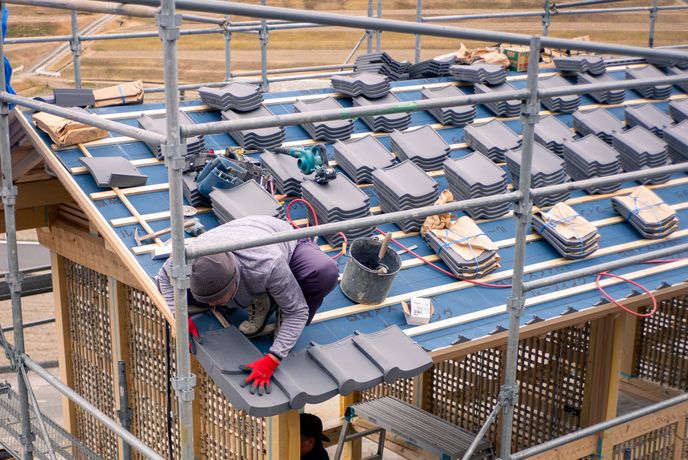
A key design feature is the intentional coexistence of different specifications, allowing visitors to experience the unique qualities and aging processes of each material. For example, roofing materials include traditional clay tiles on the main house, glazed tiles on the annex, and flat sheet metal on the shed roof. The flooring also varies in processing method between the entrance and the living room, allowing visitors to feel the difference in texture with their feet. Insulation is not used in the walls, being limited solely to the underfloor and attic spaces. This experimental approach demonstrates how a comfortable indoor environment can be achieved in both summer and winter while utilizing the ventilation and solar shading techniques inherent in traditional Japanese houses.
設計プロセスにおいては、従来のように設計図と施工図に基づき一気に進めるのではなく、工事を進めながら現場で検証·修正を繰り返すアプローチを採った。空間構成としては、かつて農機具小屋だったスペースを寝室·客間·家事スペース(離れ)に改修し、主屋との間に新たに玄関を設けた。この玄関が、賑やかな居間と静けさを求める客間との緩衝帯となり、生活と公共のスペースのバランスを生み出している。
In the design process, rather than proceeding all at once based on design drawings and construction drawings as was conventional, we adopted an approach of repeated verification and modification on-site as construction progressed. For the spatial configuration, the space that was once a farm equipment shed was renovated into a bedroom, guest room, and utility space (detached), with a new entrance hall created between it and the main house. This entrance hall serves as a buffer zone between the lively living room and the guest room seeking peace and quiet, creating a balance between private and public spaces.
主屋は従来の和風建築のように細かく区切らず、大きな一室空間とし、人が集まれる場を意識した。フランスのサロンのように、多様な人々が集い語らう場としての「居間」を目指している。縁側についても再構築を図り、もともとの障子を内障子として活用することで、縁側と居間を一体化させた。これにより、和室と洋室の要素が融合した新たな空間が生まれ、外部との繋がりもより豊かに感じられるようになった。
The main house was designed as a large open space, avoiding the traditional Japanese practice of dividing it into smaller rooms, with a conscious focus on creating a place where people can gather. It aims to be a “living room” where diverse people gather and converse, much like a French salon. The engawa veranda was also reconstructed, integrating it with the living room by repurposing the original shoji screens as interior sliding doors. This created a new space blending elements of Japanese and Western rooms, while also enhancing the sense of connection with the outdoors.
さらに、奥の和室は将来的に座禅や瞑想の場として活用できるように設計した。低い窓から庭を眺めながら静かに心を整える時間を生み出す場として、地域住民や学生が集える精神的な拠点となることを想定している。また、裏手の竹林も整備し、野点や茶会が楽しめる自然との共生空間としての展開を計画中である。
Furthermore, the inner Japanese-style room was designed to serve as a future space for zazen and meditation. It is envisioned as a spiritual hub where local residents and students can gather, creating a place to quietly center the mind while gazing at the garden through low windows. Additionally, plans are underway to develop the bamboo forest at the rear into a space for coexisting with nature, where visitors can enjoy outdoor tea ceremonies and tea gatherings.
伝統とは、過去から今、そして未来へと連鎖する永続的な人の営みである。「伝統」=「今」を主軸に古の大工と語り合い、抽出した建築の一つの答えがここにある。
ストーレンマイヤー·ジョナサン·アラン
Tradition is the continuous human practice that links the past to the present and extends into the future. Here lies one architectural answer, distilled through dialogue with ancient carpenters, with “tradition” = “the present” as its central axis.
Jonathan Allan Stollenmeyer
写真/Pictures
右真写真/和室。傷みの激しかった小屋部分をやり変え、吹抜けとした。窓を開けると風がよく通る。建具も新たにつくった左写真/居間から食堂方向を見る。縁側と居間を一体化させた
Right photo / Japanese-style room. The severely damaged shed section was rebuilt as an atrium. Opening the windows allows for excellent airflow. New doors and windows were also installed.
Left photo / View from the living room toward the dining area. The engawa veranda and living room were integrated into one space.
p.10
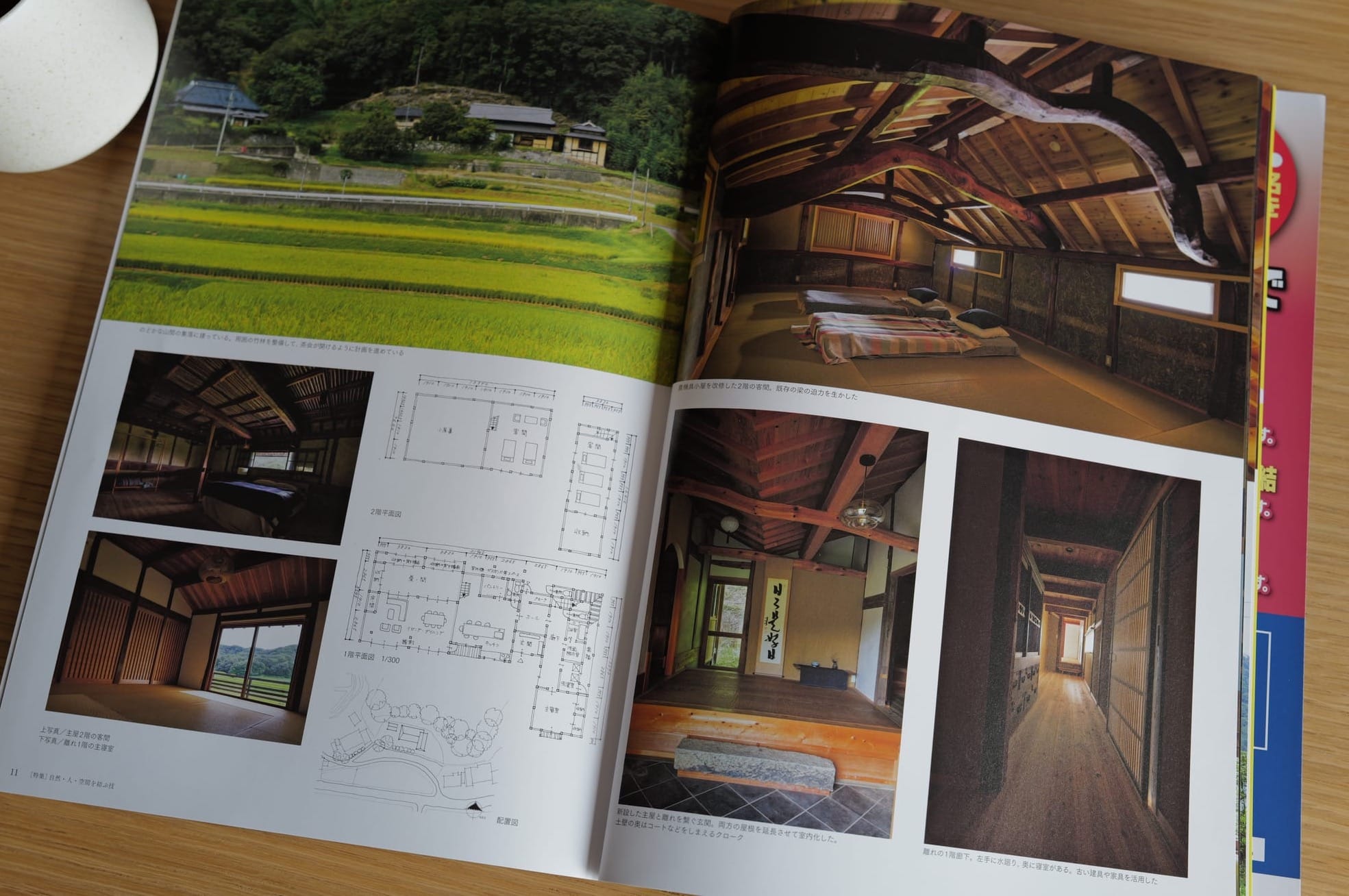
上写真:農機具小屋を改修した2階の客間。既存の梁の迫力を生かした
左下:新設した主屋と離れを繋ぐ玄関。両方の屋根を延長させて室内化した。
土壁の奥はコートなどをしまえるクローク
右下:離れの1階廊下。左手に水廻り、奥に寝室がある。古い建具や家具を活用した
Top photo: The second-floor guest room, renovated from an agricultural tool shed. The powerful existing beams were preserved.
Bottom left: The newly built entrance connecting the main house and detached building. Both roofs were extended to create an indoor space.
Beyond the earthen wall is a cloakroom for storing coats and such.
Bottom right: The first-floor corridor of the detached building. The wet areas are on the left, with the bedroom at the far end. Old fittings and furniture were reused.
p.11
写真:のどかな山間の集落に建っている。周囲の竹林を整備して、茶会が開けるように計画を進めている
上写真/主屋2階の客間
下写真/離れ1階の主寝室
The house stands in a quiet mountain village. Plans are underway to prepare the surrounding bamboo groves for hosting tea ceremonies.
Top photo: Guest room on the second floor of the main house
Bottom photo: Master bedroom on the first floor of the detached building
p.12
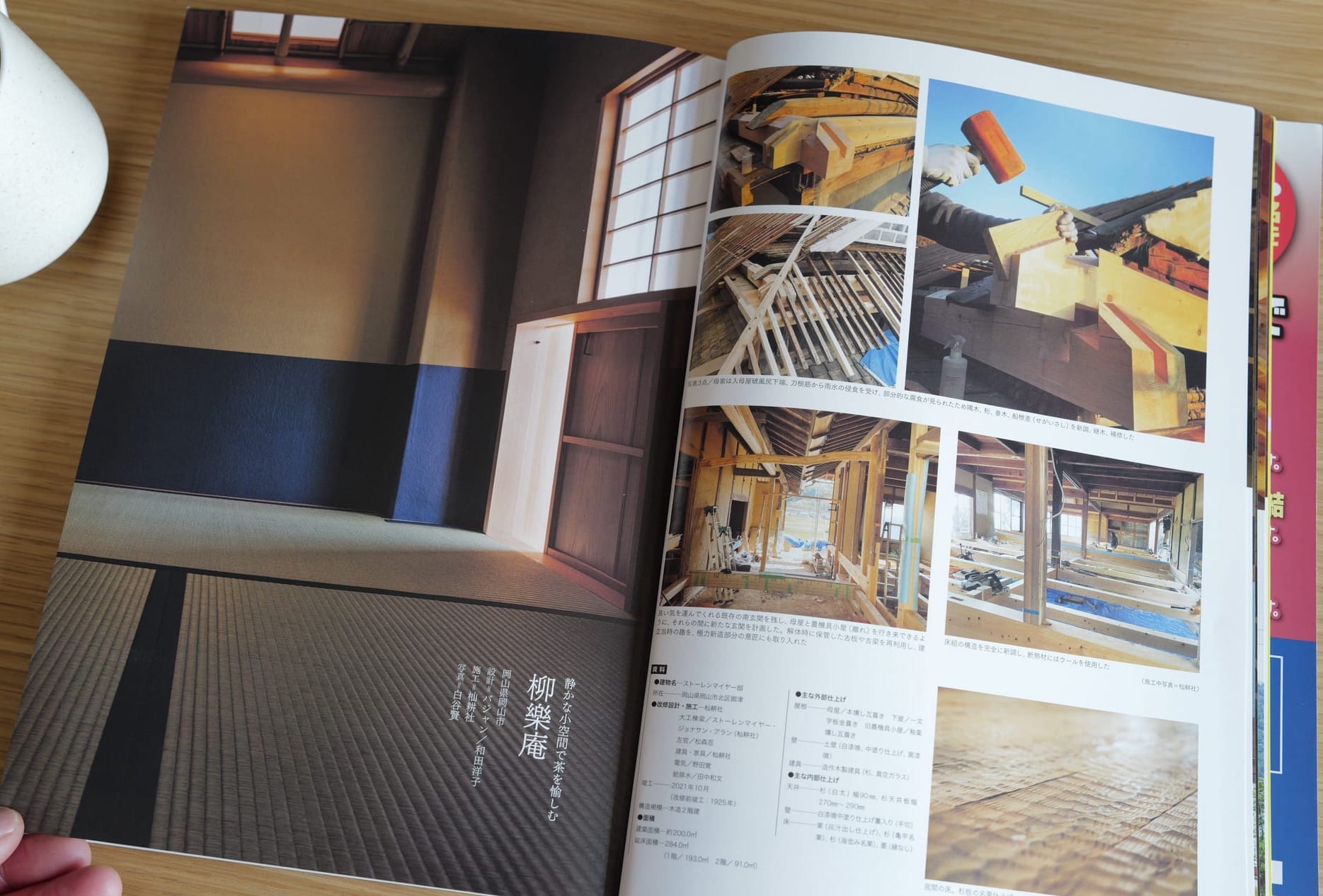
写真3点/母家は入母屋破風尻下端、刀根筋から雨水の侵食を受け、部分的な腐食が見られたため木、桁、垂木、船枻差(せがいさし)を新調、継木、補修した
中左:良い気を運んでくれる既存の南玄関を残し、母屋と農機具小屋(離れ)を行き来できるように、それらの間に新たな玄関を計画した。解体時に保管した古板や古梁を再利用し、建立当時の趣を、極力新造部分の意匠にも取り入れた
中右:床組の構造を完全に新調し、断熱材にはウールを使用した
(施工中写真 籼耕社)
右下:居間の床。杉板の名栗仕上げ
Photo 3: The main house's hip-and-gable roof eaves suffered partial decay due to rainwater erosion from the ridge beam. New timber, purlins, rafters, and extended rafters were installed, with joint repairs and wood replacement.
Center Left: Preserving the existing south entrance, believed to bring good energy, a new entrance was planned between the main house and the detached farm equipment shed to allow access between them. Reused preserved old boards and beams from demolition, incorporating the original aesthetic into the design of new sections wherever possible.
Center right: Completely renewed the floor framing structure, using wool insulation.
(Construction photo: Teikousha)
Bottom right: Living room floor. Sugi wood boards with a Naguri/adze-mark finish.
資料
●建物名―ストーレンマイヤー邸
所在―岡山県岡山市北区御津
●改修設計·施工一杣耕社
大工棟梁/ストーレンマイヤー·ジョナサン·アラン(杣耕社)
左官/松森忍
建具 家具/杣耕社
電気/野田覚
給排水/田中和文
竣工—2021年10月
(改修前竣工:1925年)
構造規模一木造2階建
●面積
建築面積一約200.0㎡
延床面積-284.0㎡
(1階/193.0㎡ 2階/91.0㎡)
●主な外部仕上げ
屋根一
母屋/本燻し瓦葺き 下屋/一文字板金葺き旧農機具小屋/釉薬燻し瓦葺き
壁土壁(白漆喰、中塗り仕上げ、黒漆喰)
建具―造作木製建具(杉、真空ガラス)
●主な内部仕上げ
天井 杉(白太)幅90mm、杉天井板幅270mm~290mm
壁 白漆喰中塗り仕上げ藁入り(手切)
床 栗(灰汁出し仕上げ)、杉(亀甲名栗)、杉(海並み名栗)、畳(縁なし)
Documentation
●Building Name―Stollenmeyer Residence
Location―Mitsu, Kita Ward, Okayama City, Okayama Prefecture
●Renovation Design & Construction―Somakosha
Master Carpenter/Jonathan Alan Stollenmeyer (Somakosha)
Plasterer/Shinobu Matsumori
Joinery & Furniture/Somakosha
Electrical/Satoru Noda
Plumbing/Kazufumi Tanaka
Completion—October 2021
(Original Construction: 1925)
Structure & Scale—Two-story Wooden Structure
●Area
Building Area—Approx. 200.0 m²
Total Floor Area—284.0 m²
(1st Floor/193.0 m² 2nd Floor/91.0 m²)
●Primary Exterior Finishes
Roof—
Main building: Hon-ibushi traditional clay tile
Shed: Straight-cut metal sheet
Old farm equipment shed: Glazed clay tile
Walls: Earthen walls (white plaster, medium coat finish, black plaster)
Joinery—Custom-built wooden joinery (cedar, vacuum glass)
●Primary Interior Finishes
Ceiling: Cedar (sapwood) 90mm wide, cedar ceiling boards 270mm~290mm wide
Walls: White plaster medium coat finish with straw (applied by hand)
Floors: Chestnut (leached finish), cedar (tortoiseshell pattern), cedar (wave pattern), tatami mats (borderless)
p.15
建主からマンションの一室を「電気炉ではなく炭を熾せる小間」にしたいとご相談を受けたのは2020年春でした。それから、マンションの一室であることを忘れてしまうような日常的に使える居心地の良い小間を目指して設計が始まりました。構造上、開口や茶道口、連子窓の位置は限定されます。三畳台目中柱、三畳、四畳半壁床など8つの案をそれぞれに楽しみながら検討を重ねました。施工は杣耕社にお願いするつもりでしたので、設計段階から建主との打合せにもご参加いただき頼もしかったです。
In the spring of 2020, the client approached us with a request to transform a room in their apartment into a “small space for burning charcoal, not an electric furnace.” From there, the design process began, aiming to create a comfortable, everyday-use space so inviting that one would forget it was a room within an apartment. Structural constraints limited the placement of openings, the tea ceremony entrance, and the lattice windows. We thoroughly explored and enjoyed evaluating eight different proposals, including a three-tatami-mat room with a central pillar, a three-tatami-mat room, and a four-and-a-half-tatami-mat room with a wall-to-floor design. Since we intended to have Somakosha handle the construction, it was reassuring to have them participate in meetings with the client from the design phase.
最終的には日常使いだけでなく、四季折々の茶会もお稽古もできるよう、点前畳は丸畳、床は半畳の桝床に落ち着きました。躙戸を開けたら滑らかに茶の世界へ入れるよう、躙口正面に床の間を配しました。床の間廻りは大徳寺聚光院の桝末席に倣い、点前座が見えやすく広さを感じられるよう、床脇壁に下地窓を設け、下を大きく開けました。壁は竹小舞下地江州土塗り壁、床板は12年前に杣耕社に建てていただいた住宅の床板の共木で姫小松の一枚板、床柱は赤松皮付き、廻縁は杉と香節皮付きです。壁留は40年間材木屋で眠っていた栗名栗です。天井の杉や竹たちは新しく、爽やかになりすぎそうなところを栗名栗が渋く抑えてくれていると感じます。炉は向切と台目切の2カ所に設けて、さまざまなお点前に対応できるようにしました。使わない炉は畳を入れ替えて隠します。炉では炭を熾すので換気は重要です。外気に面した換気扇の前に障子を建て込み、炭をしている時は障子を少し開けて有効に換気をします。
Ultimately, the temae-tatami(tea preparation area) settled on the maru-tatami(one full tatami-mat size) for daily use, while the floor space features the masu-doko(a half-tatami mat size) to accommodate seasonal tea gatherings and practice sessions. To ensure a smooth transition into the tea world upon opening the sliding door, the tokonoma alcove was positioned directly ahead of the entrance. Following the example of the masu-sue-seki seating area(the closest seating area from an entrance) at Daitoku-ji's Shukō-in temple, we installed a lower window in the wall beside the tatami mat to provide a clear view of the tea preparation area and create a sense of spaciousness. The walls feature bamboo latticework with a base layer made with Goshu clay plaster. The floorboards are single-piece Hime-komatsu pine wood, matching the flooring from a residence built by Somokōsha twelve years ago. The toko-bashira alcove pillars are red pine with bark, while the crown molding is cedar with fragrant knots and bark. The kabe-dome(a small, functional, and decorative piece of wood or bamboo fixed at the bottom of a partial wall) are chestnut wood that had been stored for forty years at a lumberyard. The new cedar and bamboo ceiling elements risked appearing overly fresh, but the chestnut trim provides a restrained, subdued counterbalance. Two hearths—a mukou-kiri(Sunken hearth on the guest's side) and a daime-kiri(another sunken hearth inside the guest's mat which is a smaller than normal (3/4) mat)—were installed to accommodate various tea ceremony styles. The unused hearth is concealed by replacing the tatami mats. Ventilation is crucial since charcoal is burned in the hearth. A shoji screen was built in front of the exterior-facing ventilation fan. During charcoal use, the screen is partially opened to ensure effective airflow.
空調計画も難題でしたが、配管経路や機器の収まりを専門業者が検討を重ねてくださり、本体は廊下天井上に設置しました。樹脂の吹出し口では興醒めなので、杉でつくっていただきました。とても美しく杉の平天井に馴染んでいます。照明設備は突き上げ窓に見立てました。必要な設備が静かに美しく納まりました。
The HVAC plan was also a challenge, but specialized contractors carefully reviewed the piping routes and equipment placement, ultimately installing the main unit above the hallway ceiling. Since plastic vents would have been disappointing, we had them crafted from cedar. They blend beautifully with the cedar flat ceiling. The lighting fixtures were designed to resemble transom windows. The necessary equipment was quietly and elegantly integrated.
小間完成後、廊下に小さな水屋を設けました。現在は建主とベランダ茶庭の案を練っています。
After completing the small room, we installed a small kitchen in the hallway. We are currently working with the client on plans for a balcony tea garden.
和田洋子/バジャン
Yoko Wada / BAJANE architectural firm
*
施工でこだわったところを細かく取り上げれば一晩語り明かせるほどたくさんありますが、全体として違和感なく落ち着いた空間をつくることができたのではないかと感じています。建築や茶室のことを何も知らなくても、足を踏み入れた瞬間に、「わあ、素敵な空間ですね」と言っていただけたら成功したと言えるのかなと思います。私たち施工者の奮闘が表に見える必要はなく、ただ素直にいいなと感じてもらえたら、これほどに嬉しいことはありません。
If I were to go into detail about every aspect we focused on during construction, I could talk all night long. But overall, I feel we succeeded in creating a space that feels calm and natural. Even if someone knows nothing about architecture or tea rooms, when they step inside and say, “Wow, what a wonderful space,” I believe that’s success. Our hard work as builders doesn’t need to be visible; if people simply feel genuinely impressed, nothing could make us happier.
山本耕平/杣耕社
Kohei Yamamoto / Somakosha
13頁写真/開口方向を見る。開口のある壁は唯一屋外に接しており、戸を開けると自然光が差し込み、連子窓からは障子を通して柔らかな明るさがもたらされる右写真/桝席に倣った半間角の踏込床。床脇壁の下を抜き、上は床が透けるよう下地窓を設けているので、床が孤立せず点前座に開放感を与えている
上写真/床柱は向切炉の出隅に建ち、中柱のように軽やかである。点前座はほの暗く、床廻りや連子窓辺りはほの明るい。静かでなだらかな陰影が心地良い
Page 13 Photo / View of the opening direction. The wall with the opening is the only one directly connected to the outdoors. Opening the door allows natural light to stream in, while soft brightness filters through the shoji screens from the lattice windows.
Right Photo / A half-ken square tatami size Humikomi-doko floor following the Masu-seki style. The lower part of the wall beside the floor is open, and a base window is installed above to allow the floor to be seen through. This prevents the floor from feeling isolated and gives the tea preparation area an open feel.
Top photo: The tokobashira alcove pillar stands at the corner of the mukoukiri hearth, light and airy like a nakabashita middle pillar. The tea preparation area is dimly lit, while the alcove surroundings and latticed window area are softly bright. The quiet, gentle shadows create a pleasant atmosphere.
p.16
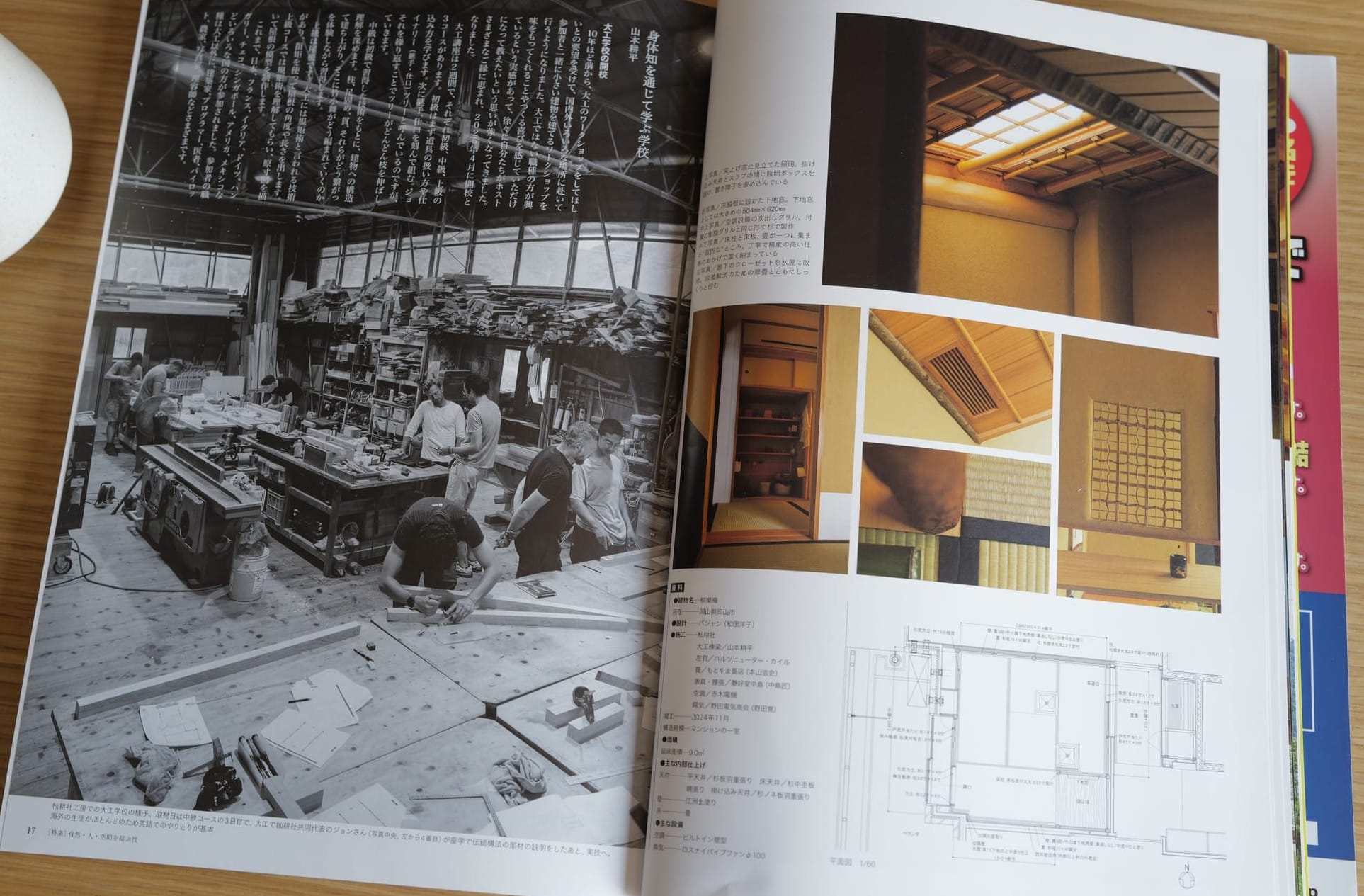
上写真/突上げ窓に見立てた照明。掛け込み天井とスラブの間に照明ボックスを設け、置き障子を嵌め込んでいる
右写真/床脇壁に設けた下地窓。下地窓としては大きめの504mm✕620mm
中上写真/空調設備の吹出しグリル。付属の樹脂グリルと同じ形で杉で製作
中下写真/床柱と床板、畳が一つに集まる”面倒なところ。丁寧で精度の高い仕事のおかげで潔く納まっている
左写真/廊下のクローゼットを水屋に改修。段差解消のための厚畳とともにしっくりと佇む
Top photo: Lighting designed to resemble a top-hung window. A light box is installed between the sloped ceiling and slab, with a paper screen fitted inside.
Right photo: A base window installed in the side wall. Measuring 504mm x 620mm, which is larger than typical for a base window.
Center top photo / Air conditioning vent. Crafted from cedar to match the shape of the built-in resin vent.
Center bottom photo / The “tricky spot” where the floor pillar, floorboards, and tatami mat converge. Thanks to precise, careful work, it’s finished cleanly.
Left photo / The hallway closet converted into a small kitchen. It sits comfortably alongside the thick tatami mat used to eliminate the step.
資料
●建物名―柳樂庵
所在―岡山県岡山市
●設計―バジャン(和田洋子)
施工―杣耕社
大工棟梁/山本耕平
左官/ホルツヒューター·カイル
畳/もとやま畳店(本山浩史)
表具·腰張/静好堂中島(中島匠)
空調/赤木電機
電気/野田電気商会(野田覚)
竣工―2024年11月
構造規模―マンションの一室
●面積
延床面積一9.0m
●主な内部仕上げ
天井―平天井/杉板重張り 床天井/杉中杢板鏡張り 掛け込み天井/杉ノネ板羽重張り
壁―江洲土塗
床―舋
●主な設備
空調―ビルトイン整型
換気―ロスナイパイプファンφ100
Documentation
●Building Name―Yuraku-an
Location―Okayama City, Okayama Prefecture
●Design―BAJANE (Yoko Wada)
Construction―Somakosha
Master Carpenter/Kōhei Yamamoto
Plasterer / Holzhüter Kyle
Tatami / Motoyama Tatami Shop (Hiroshi Motoyama)
Scroll Mounting & Washi Wall Covering / Seikodo Nakajima (Takumi Nakajima)
HVAC / Akagi Denki
Electrical / Noda Denki Shokai (Satoru Noda)
Completion ― November 2024
Structure Scale ― Apartment Unit
●Area
Total floor area: 9.0m²
●Main Interior Finishes
Ceiling
Flat ceiling / Layered cedar boards
Floor ceiling / High-grade cedar boards
Sloped ceiling / Layered cedar tongue-and-groove boards
Walls ― Goshu clay plaster
Floors ― Tatami mats
●Main Equipment
Air conditioning ― Built-in standard unit
Ventilation ― Lossnay pipe fan φ100
p.17
身体知を通じて学ぶ学校
山本耕平
A School for Learning Through Body Knowledge
Kohei Yamamoto
大工学校の開校
10年ほど前から、大工のワークショップをしてほしいとの要望を受けて、国内外いろいろな場所に赴いて参加者と一緒に小さい建物を建てるワークショップを行うようになりました。大工ではない職種の方が興味をもってくれることやつくる喜びを感じていただけているという実感があって、徐々に自分たちがホストになって教えたいという思いが強くなってきました。さまざまなご縁に恵まれ、202年4月に開校となりました。
Opening of the Carpenter School
About ten years ago, we began receiving requests to hold carpentry workshops. We started traveling to various locations both domestically and internationally to conduct workshops where participants built small structures together. We felt a growing sense of fulfillment seeing people from non-carpentry professions take an interest and experience the joy of creating. Gradually, our desire to host and teach ourselves grew stronger. Blessed with various connections, we opened our doors in April 2020.
大工講座は2週間で、それぞれ初級、中級、上級の3コースがあります。初級はまず道具の扱い方や仕込み方を学びます。次に継手、仕口を刻んで組む。ジョイナリー(離手·仕口)ツリーと呼んでいるのですが、それを繰り返すことでツリーがどんどん枝を伸ばしていきます。
Our carpentry workshop runs for two weeks and offers three courses: beginner, intermediate, and advanced. Beginners first learn how to handle tools and prepare materials. Next, they cut and assemble joints and mortises. We call this the “joinery tree”—by repeating this process, the tree steadily grows more branches.
中級は初級で習得した技術をもとに、建物への構造理解を深めます。柱、足固め、貫、それらがどう繋がって建ち上がり、そこに小舞がどう編まれていくのかを体験しながら習得します。
The intermediate level builds upon the techniques learned in the beginner level to deepen your understanding of building structures. You will learn through hands-on experience how pillars, footings, and horizontal beams connect to form the framework, and how the bamboo latticework is woven into place.
上級は屋根です。大工には規矩術と言われる技術があり、指矩を使って屋根の角度や長さを出します。上級コースでは規短術を理解してもらい、原寸図を描いて屋根の模型を制作します。
The advanced course focuses on roofs. Carpenters use a technique called “Kiku-Jutsu:the stereotomy with a carpenter's square” employing a square to determine roof angles and lengths. In the advanced course, students learn the principles of kiku-jutsu work, draw full-scale drawings, and construct roof models.
これまで、日本、フランス、イタリア、ドイツ、パンガリー、チェコ、シンガポール、アメリカ、メキシコなどいろいろな国の方が参加されました。参加者の職種は大工以外に、建築家、プログラマー、医者、パイロット、農家、写真家、理容師などさまざまです。
Participants have come from various countries including Japan, France, Italy, Germany, Hungary, the Czech Republic, Singapore, the United States, and Mexico. Beyond carpenters, participants have included architects, programmers, doctors, pilots, farmers, photographers, barbers, and many others.
杣耕社工房での大工学校の様子。取材日は中級コースの3日目で、大工で杣耕社共同代表のジョンさん(写真中央、左から4番目)が座学で伝統工法の部材の説明をした後、実技へ。海外の生徒がほとんどのため英語でのやり取りが基本
Scenes from the carpentry school at Somkosha Workshop. On the third day of the intermediate course, John (center in photo, fourth from left), a carpenter and co-representative of Somakosha, explained traditional construction methods and components during classroom instruction before moving to practical work. Communication is primarily in English, as most students are from overseas.
p.18
技術実習
1*/初級コースでは、ノミ、カンナ、ノコギリといった道具の手入れの仕方から使い方を学び、継手、仕口を実際に刻んで組む
2*/生徒の後ろで見守る山本さん
3~6/中級コースの様子。ジョンさんがまずは手本として墨付けをやって見せ、その後各々で作業を進める。生徒たちの眼差しは真剣そのもの。中級コースでは柱、足固め、貫といった部材の意味を学びながら、墨付け、刻み、組み立てを行い、壁をつくっていく。6がそのモデル。今回の講座では、最終的には生徒一人ひとりが墨付けして刻んだ部材を組んで4辺の壁を繋ぎ、一つの建物として完成させる
7*·8*/上級コース。規矩術を使って屋根の原寸図を描いて部材の寸法や角度を出し、そのモデルを施行する
(17頁~19頁写真=白谷賢*写真提供=杣耕社)
Technical Training
1*/In the beginner course, students learn how to maintain and use tools like chisels, planes, and saws, then actually cut mortise and tenon, and assemble joints.
2*/Yamamoto watches over the students from behind.
3-6/Intermediate Course. John first demonstrates marking out as an example, after which each student proceeds with their own work. The students' gazes are utterly focused. In the Intermediate Course, while learning the purpose of components like posts, footings, and horizontal beams, students perform marking, carving, and assembly to build walls. 6 shows the model. In this workshop, each student ultimately assembles the components they marked and carved to connect four walls, completing a single structure.
7*·8*/Advanced course. Using traditional drafting techniques, they draw full-scale roof plans to determine member dimensions and angles, then construct the model.
(Photos on pages 17–19 = Ken Shiratani*Photo provided by Somosha)
p.19
参加者で意外と多かったのは自分で家を建てたいから応募したという方です。また日本の大工道具や、精密な細工に惹かれたという方もいます。彼らからすると、日本の1mm以下を突き詰めるという感覚が興味深く見えるようです。
実習以外には、現場の見学や「柳楽庵」(13頁、上写真)でのお茶体験もあります。建主はお茶を長年続けられていて、この茶室を公に開いていきたいという思いをもたれていたこともあり、快く引き受けてくださいました。自分たちが施工した茶室を生徒の皆さんに見てもらえるし、お茶の世界も知ってもらえる良い機会だと思います。他にも岡山後楽園や木材屋さん、竹中大工道具館などの見学にも行きます。
Unexpectedly, many participants applied because they wanted to build their own homes. Others were drawn to Japanese carpentry tools and the precision craftsmanship. To them, the Japanese obsession with accuracy down to less than 1mm seems fascinating.
Beyond the practical training, there are site visits and tea ceremonies at “Yuraku-an” (page 13, top photo). The owner, who has practiced tea ceremony for many years and wished to open this tea room to the public, kindly agreed to host us. It's a great opportunity for the students to see the tea room they helped build and learn about the world of tea ceremony. We also visit Okayama Korakuen Garden, lumberyards, and the Takenaka Carpentry Tools Museum.
技を身体知的に習得する
私は授業の最初にこう説明します。「日本は世界でも類い稀なハイコンテクスト文化です。物事を習得する過程で言語での説明理解ではなく、見て真似る、修正し次に繋げることに重きをおきます。」やって見せて、「あとはどうぞ」って投げる。もちろん言葉も交えますが、自分の修業や弟子を育ててきた経験から察すると、おそらくインプットは5%くらいで、残りの95%は自分の身体でつくることのなかに習得するための過程があると信じています。例えば初めて字を書くときは真似から入りますよね。筆の使い方の知識は必要ですが、100回、1000回と繰り返してお手本のように書けるようになって初めて自分の線が現われ始める。大工も同じで、研ぎから始まり、反復練習をするなかで見えてくるものがあります。疑問があったらまず一度自分でなぜかを考えてから質問すると、知識が知恵に変わりやすいとも伝えています。
Mastering Skills Through Body Knowledge
I begin my lessons by explaining: "Japan is a remarkably high-context culture. In the process of learning things, the emphasis is not on understanding verbal explanations, but on observing, imitating, correcting, and advancing to the next step.“ I demonstrate, then say, ”Now it's your turn." Of course, I also use words, but based on my own training and experience teaching apprentices, I believe that perhaps only about 5% comes from verbal input. The remaining 95% lies in the process of learning through creating with your own body. For example, when writing characters for the first time, you start by imitating, don't you? Knowing how to use a pen is necessary, but only after repeating it 100 or 1000 times until you can write like the model does your own lines begin to emerge. Carpenters are the same; it starts with sharpening, and through repetitive practice, things become visible. If you have a question, first try to figure out why on your own before asking—this helps knowledge turn into wisdom.
ふだん大工として身体でやっていることを言語に置き換えて教えようとすると、いかに人が身体知で生きているかということに気づかされます。私は生徒に、「皆さんは歯磨きのエキスパートだ」と説明します。歯ブラシで、自分の歯の形状と、指、関節の動かし方でどう汚れを取るか。自分の身体能力で自然とそれができていて、毎日反復的にやっていることが体にそうさせているのです。ちょっと話が変な方向に行きましたが(笑)、大工作業には言語化できない身体知的な領域が多くあります。生徒が刻んでいるときに後ろに回ってちょっと手を添えて、「この方が狙いやすくない?」とか、「こうしたらノミの通りが軽くなるよね」みたいに、彼らにとって添え木のような存在になれたらいいのかもしれません。身体で理解するということのきっかけになれたらいいなと思っています。
やまもと·こうへい談
When I try to translate the physical actions I perform daily as a carpenter into words to teach others, it makes me realize just how much people live by physical knowledge. I explain to my students, “You are all experts at brushing your teeth.” Using a toothbrush, you naturally know how to remove plaque based on the shape of your teeth and how to move your fingers and joints. Your physical abilities allow you to do this effortlessly, and the daily repetition has ingrained it into your body. I digressed a bit there (laughs), but carpentry involves many areas of physical knowledge that cannot be put into words. When a student is chiseling, I might stand behind them, gently guide their hand, and suggest, “Wouldn't this make it easier to aim?” or “Trying it this way might make the chisel cut more smoothly.” I hope I can be like a brace for them and can be a spark for them to understand things physically.
Kohei Yamamoto
茶の湯体験
「柳楽庵」でのお茶体験の様子。開口から入り、お茶をいただくまでの一連の流れを建主が講師となって生徒たちに教える。「お茶は茶の入れ方、出し方、頂き方などすべてにおいて作法が細かく決まっていますが、長い歴史のなかで無駄が削ぎ落とされて洗練されていったかたちであり、所作が美しく見えます」と建主。生徒の大半は海外の方だが、茶室に使われている素材の種類や使い方、軸に書かれている内容についてなど、途切れることなく質問が飛び交った。「こんなところまで見ているのかと毎回驚かされる」と建主、設計者の和田さん、山本さんは口を揃える
Tea Ceremony Experience
A tea ceremony experience at “Yuraku-an.” The owner serves as instructor, guiding students through the entire sequence from entering the tea room to receiving the tea. “Tea ceremony has meticulous rules governing everything from brewing and serving to drinking,” explains the owner. “Yet these forms, refined over centuries by eliminating unnecessary elements, create movements of great beauty.” Though most students are international visitors, questions flowed continuously about the types and uses of materials in the tea room, the content of the hanging scrolls, and more. “I'm always surprised by how much detail they notice,” the owner, designer Wada, and the carpenter Yamamoto all agree.
岡山空港から車で約15分、山間の地域、津紙工(みつしとり)にある杣耕社の工房。現在はここで生徒たちが学ぶが、2026年からは近くに作業場を新設し、そこで開校する予定だという
About a 15-minute drive from Okayama Airport lies the workshop of Somakosha in the mountainous region of Mitsushitori. While students currently learn here, plans call for establishing a new workshop nearby starting in 2026, where classes will then be held.
Subscribe